Home
Explore Uedu
Student Console
Register as Member/Login
Research Informed Consent Center
問卷中心
Teacher Console
Course Setup
Support & Messages
Uptime Data

UeduGPTs

--

Jupyters

8

Local AI

--

CISOSE26 本地 AI UG26
中央大學 AQI 58 29°C PM2.5 13

AI Reply Desktop Notifications

Show a desktop notification when the AI TA finishes replying

Chat Message Notifications

Notify me when classmates post messages in the forum

Sound notification

Play an alert sound whenever there is a new notification

Uedu Open / Introduction to Special Relativity
8.20

Introduction to Special Relativity

Prof. Markus Klute | January IAP 2021
Science & Math Physics Relativity Science
前往原始課程
CC BY-NC-SA 4.0
課程簡介
The theory of special relativity, originally proposed by Albert Einstein in his famous 1905 paper, has had profound consequences on our view of physics, space, and time. This course will introduce you to the concepts behind special relativity including, but not limited to, length contraction, time dilation, the Lorentz transformation, relativistic kinematics, Doppler shifts, and even so-called “paradoxes.”
Course Information
SourceMIT 開放式課程
科系Physics
LanguageEnglish
影片數52
課程影片 (52)
1
1.1 Course Organization (8.20 Introduction to Special Relativity)
2
1.2. Prof. Klute’s Research
3
1.3 History of Special Relativity
4
1.4 Guest Lecture: Space, Time, and Spacetime  
5
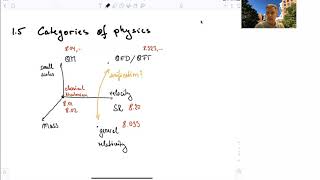
1.5 Categories of Physics
6
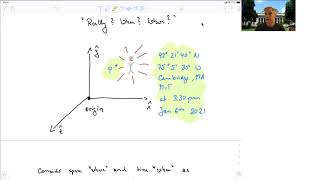
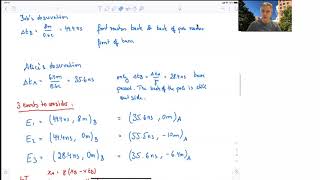
2.1 Events
2.1 Events
7
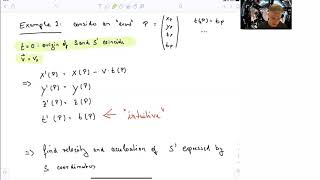
2.2 Galilean Transformation
8
3.1 Light
3.1 Light
9
3.2 Waves
3.2 Waves
10
3.3 Michelson-Morley Experiment
11
3.4 Stellar Aberration
12
4.1 Time Dilation
4.1 Time Dilation
13
4.2 Muons
4.2 Muons
14
4.3 Length Contraction
15
4.4 Invariance
4.4 Invariance
16
4.5 Lorentz Transformation
17
5.1 Voyager Program
5.1 Voyager Program
18
5.2 Velocity Addition
19
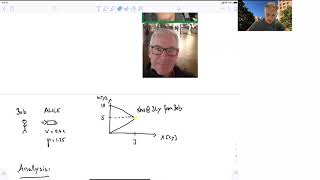
5.3 Spacetime Diagrams
20
5.4 Regions in Spacetime Diagrams
21
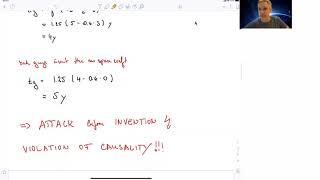
5.5 Causality
5.5 Causality
22
6.1 Pole-in-the-Barn Paradox
23
6.2 Twin Paradox
6.2 Twin Paradox
24
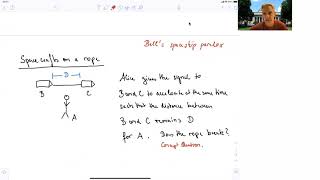
6.3 Spacecraft-on-a-Rope Paradox
25
7.1 Introduction to the Doppler Effect
26
7.2 Relativistic Doppler Effect
27
7.3 Redshift
7.3 Redshift
28
7.4 Galaxy Travel
7.4 Galaxy Travel
29
8.1 Algebra of Lorentz transformations
30
8.2 Introduction to 4-Vector Notation
31
8.3 Proper Velocity
8.3 Proper Velocity
32
9.1 Momentum Conservation
33
9.2 Energy Conservation
34
9.4 Forces and Kinetic Energy
35
9.3 Collisions
9.3 Collisions
36
10.1 Tests of Special Relativity
37
10.2 The Large Electron-Positron Collider
38
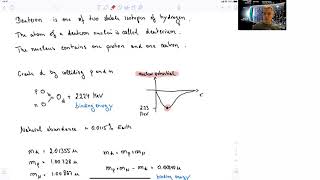
10.3 Deuteron Production
39
10.4 Absorption and Emission of Photons
40
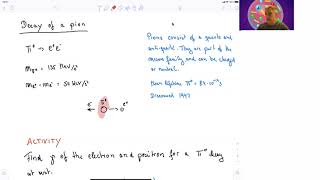
10.5 Decay of a Pion
41
10.6 Creation of Particles
42
10.7 Compton Effect
10.7 Compton Effect
43
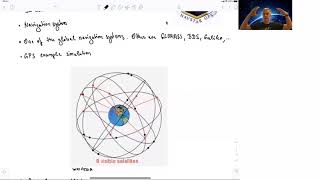
10.8 Global Positioning System
44
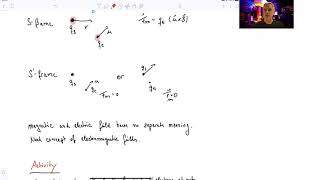
11.1 Charge and Current
45
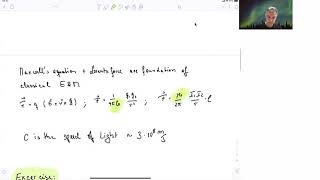
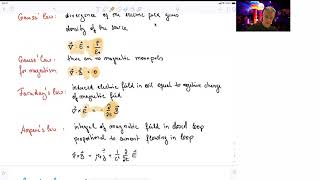
11.2 Electric and Magnetic Fields
46
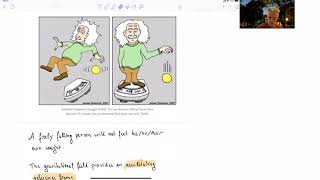
12.1 Equivalence Principle
47
12.2 Time Dilation Effect on Earth
48
12.3 Bending of Light
49
12.4 Redshift Tests
12.4 Redshift Tests
50
12.5 General Relativity
51
12.6 Experimental Evidence 
52
13.2 Course Review 
13.2 Course Review